The benefits of tax-loss harvesting

Tax-loss harvesting (TLH) is a portfolio management technique that uses realised investment losses to offset taxable gains, with the goal of improving after-tax outcomes over time.
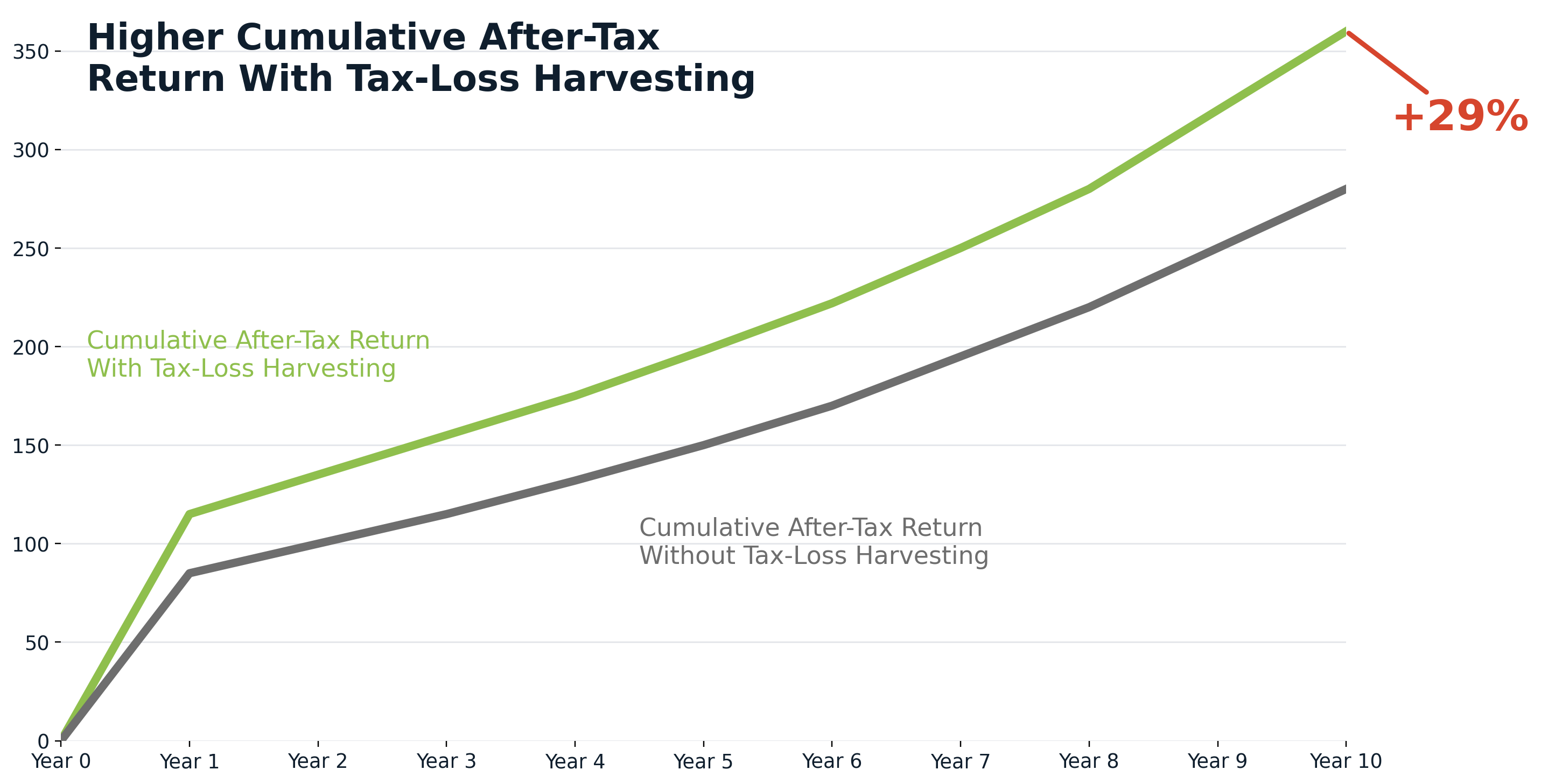
Research published by Vanguard (July 2024) suggests that, under certain assumptions, TLH can lead to meaningfully higher after-tax performance over a ten-year period compared with holding a similar exposure via an ETF or mutual fund without loss harvesting.
Get Started
Get Started
Line chart comparing cumulative after-tax returns with and without tax-loss harvesting over a ten-year period, showing higher returns with tax-loss harvesting.
29%
Potential after-tax performance over ten years

What research says about tax-loss harvesting benefits

TLH can produce higher cumulative after-tax performance than a comparable equity ETF or mutual fund.
The benefit tends to be strongest in earlier years and gradually declines as portfolios appreciate and fewer losses become available — a phenomenon known as ossification.
When expressed on a cumulative basis, the study observed a potential after-tax performance uplift of roughly 29% over ten years, under the study’s assumptions.

Why tax-loss harvesting can improve after-tax efficiency?

The potential effectiveness of tax-loss harvesting is influenced by several factors:
01
Tax Rates and Investor Profile
Higher marginal tax rates generally increase the relative value of harvested losses.
02
Market Volatility and Asset Structure
Price fluctuations create more frequent opportunities to realise losses, particularly when portfolios hold individual securities rather than a small number of broad-market ETFs.
03
Reinvestment and Loss Availability
Reinvesting proceeds associated with harvested losses can help replenish future loss opportunities and reduce the long-term effects of ossification.
04
Evaluation Frequency
More frequent analysis captures loss opportunities that periodic or annual reviews may miss.
Want to learn more about us?
About Us
About Us

Limitations and important considerations

Tax-loss harvesting does not eliminate taxes and should be understood primarily as a tax deferral mechanism. Harvested losses may increase future unrealised gains, which could become taxable when positions are eventually sold.
Actual outcomes depend on a wide range of factors, including market conditions, portfolio composition, tax regimes, and individual investor circumstances.
This content is provided for educational purposes only and does not constitute investment, tax, or legal advice. Results referenced are hypothetical, based on historical data and stated assumptions, and do not guarantee future outcomes.
Research Source:
Paradise, T., Khang, K., & Dickson, J. (2024). Tax-loss harvesting: why a personalized approach is important. Vanguard Research.
Get started
Get started