
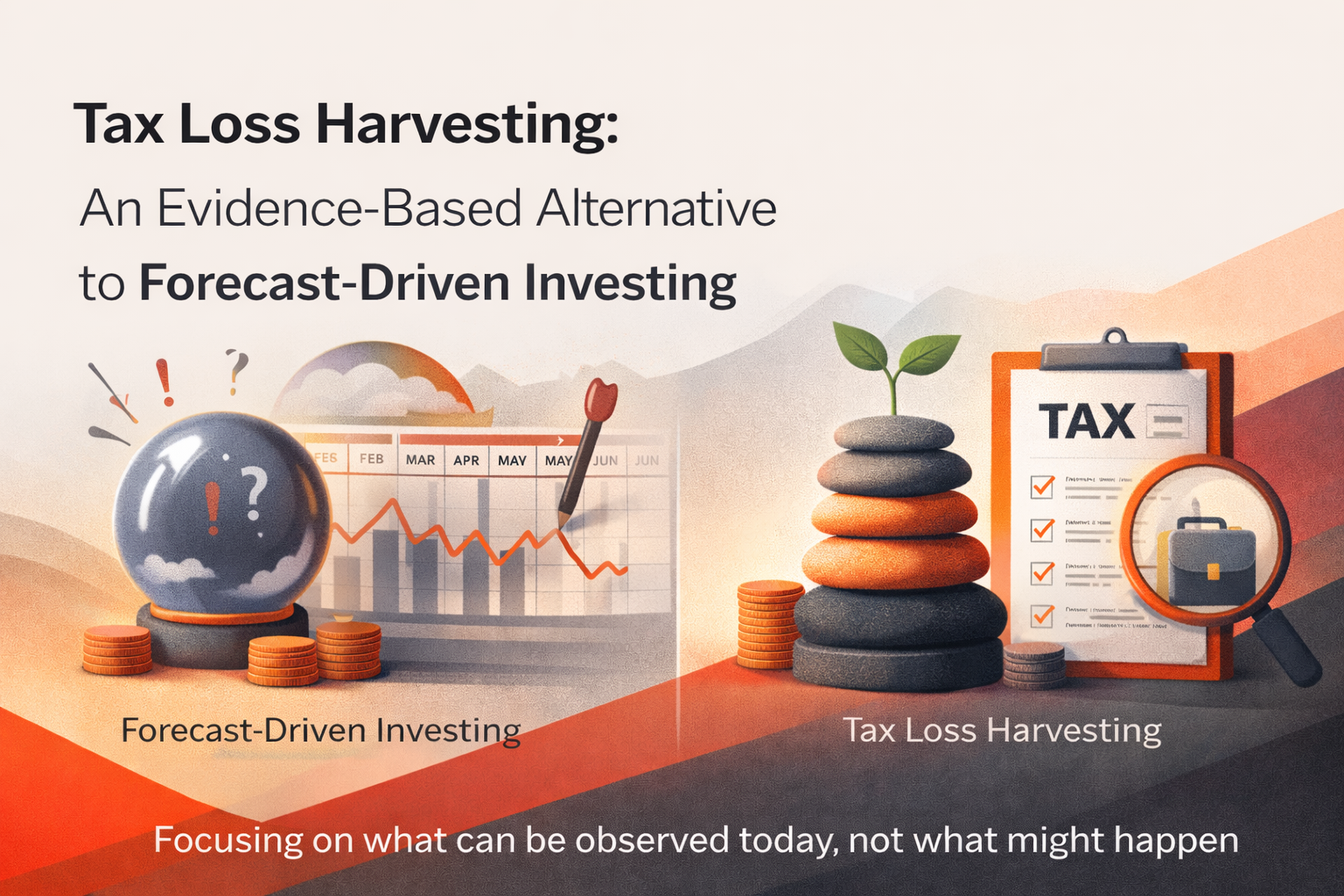
The limits of prediction
Economic forecasts routinely conflict. Asset class outlooks change rapidly. Even when forecasts are broadly correct, markets often price them in faster than investors can act.
The result is a narrow margin for error - and little room for taxes. Tax loss harvesting does not attempt to forecast returns. Instead, it improves how returns are retained.
A mechanical approach to after-tax optimisation
At its core, tax loss harvesting is a mechanical process:
- Reconstruct historical tax lots
- Identify unrealised losses
- Apply deterministic rules to surface potential offsets
Because the process is rules-based, it can be documented, audited, and consistently applied. This transparency makes tax loss harvesting particularly well-suited to professional portfolio oversight.
Complementary, not competitive
Tax loss harvesting does not compete with asset allocation, diversification, or long-term portfolio design. It complements them.
While strategic decisions shape expected returns, tax loss harvesting focuses on how much of those returns remain after tax - a dimension often overlooked in performance discussions.
Focusing on certainty in an uncertain world
No strategy can eliminate uncertainty. But some strategies are less dependent on prediction than others.
Tax loss harvesting stands out because it relies on observable data, applies consistent logic, and targets after-tax outcomes rather than speculative upside.
In an environment where forecasting errors are inevitable, tax loss harvesting offers a disciplined way to improve results by focusing on what can be analysed today - not what might happen tomorrow.