
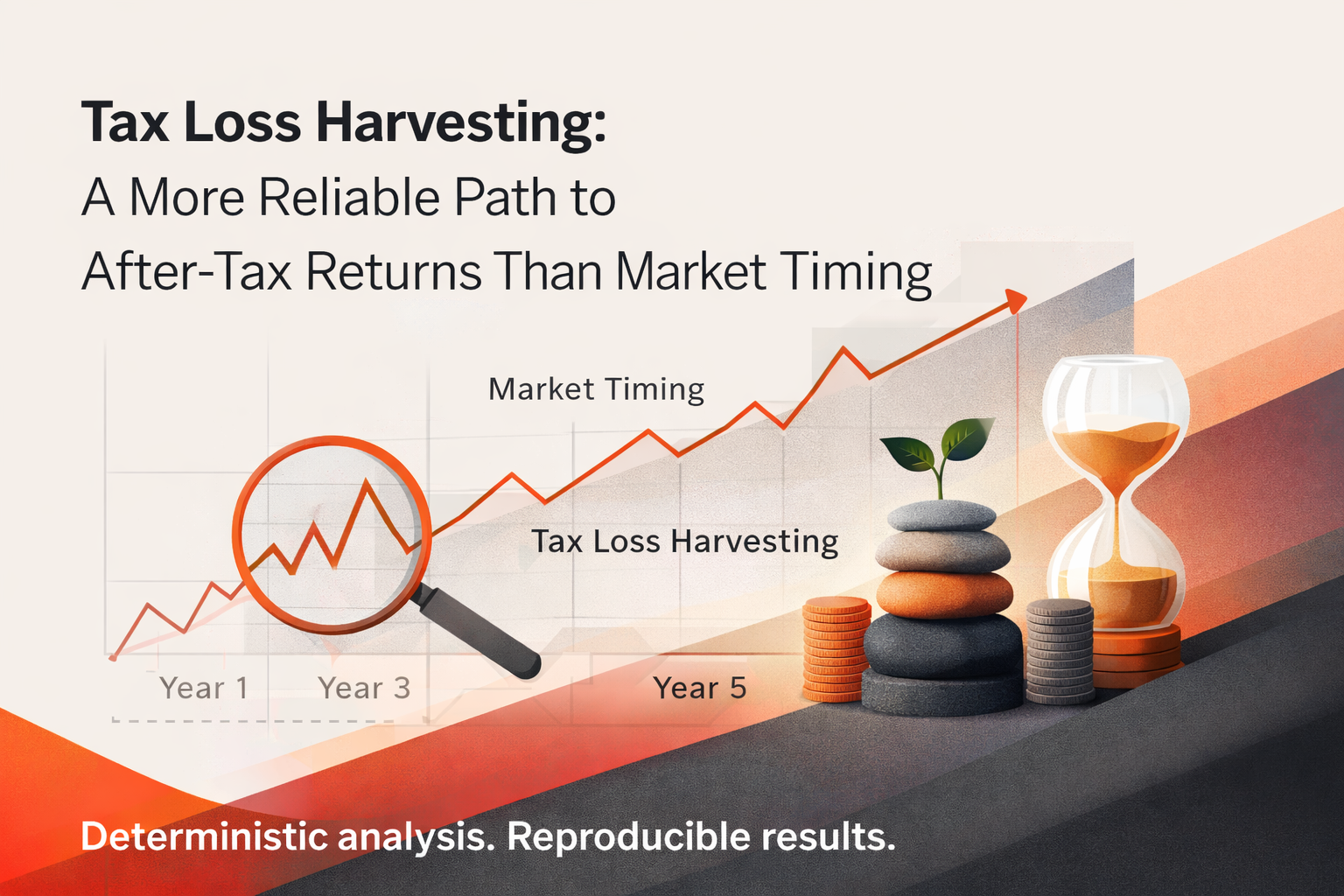
Why market timing struggles to deliver consistent value
Market timing relies on being right twice - when to exit and when to re-enter. Missing even a handful of strong market days can materially reduce long-term returns. Timing errors compound quickly and can disproportionately hurt outcomes.
More importantly, market timing seeks pre-tax alpha - returns generated before tax - without accounting for how much of that return survives after tax.
Why tax loss harvesting targets after-tax efficiency
Tax loss harvesting works by systematically identifying unrealised capital losses and using them to offset realised gains elsewhere in a portfolio. The goal is not higher gross returns, but greater retention of returns after tax.
This distinction matters because taxes are one of the few costs that meaningfully compound over time. Reducing tax leakage - even modestly - can improve cumulative outcomes without requiring superior forecasts or increased risk.
Research published by firms such as Vanguard suggests that, under certain assumptions, tax loss harvesting can contribute meaningfully to after-tax performance over long horizons.
A process built on control, not prediction
The core advantage of tax loss harvesting is that it operates on known inputs:
- Historical trade data
- Current market prices
- Explicit tax rules
It does not require a view on future market direction. Instead, it applies a repeatable, rules-based process to surface potential opportunities for review.
In a world where uncertainty dominates forecasts, tax loss harvesting stands out as a disciplined way to improve outcomes by focusing on what investors can control - not what they hope will happen next.